Engineering basis
From vehicle dynamics to a tactile carrier.
MCP4SH does not choose one frequency and call it physics. It sits between three different systems: what the vehicle is doing, what our sense of touch can read, and what the rig can physically reproduce.
This page collects some of the public research and engineering context behind that way of thinking, including the driving-coaching "String Theory" analogy that inspired the name. It is supporting context, not a claim that one driving analogy or one published frequency maps directly to one haptic effect.
The short version
Interpret the event first; then choose a tactile expression that can actually work.
The natural motion of a car, the vibration that reaches a seat or steering wheel, the sensitivity of touch, and the useful range of a tactile transducer are not the same thing.
MCP4SH therefore does not try to copy every real-world frequency one-to-one. It uses vehicle state and relationships to identify useful events, then renders those events within a tactile range that can be perceived and reproduced.
Tyres, suspension, chassis, drivetrain and road input evolve on their own physical time scales.
Frequency, amplitude, timing and body location all change what a vibration feels like.
Shakers, mounts, seats, frames and pedal plates reshape the signal again.
String Theory in driving
The name starts with a driving-coaching technique: blend the inputs instead of treating them as separate switches.
In track-driving instruction, "string theory" or the "string analogy" imagines an invisible string connecting the steering wheel to the brake and/or throttle pedal. The simple lesson is that as steering demand rises, the driver generally releases some longitudinal input; as the wheel opens, more braking or acceleration capability becomes available. It is closely related to the traction-circle idea and to teaching smooth trail-brake release.
That is the inspiration behind the MCP4SH name. It is not used as a literal linear formula inside the plugin. Real cars, tyres and drivers are more complicated than the beginner analogy; advanced coaching sources explicitly account for rotation, feedback, line, timing and vehicle behaviour. MCP4SH carries forward the useful part of the idea: interpret related inputs and states as a coupled system rather than treating every signal as an isolated effect.
Frequency context
Different parts of the problem live in different bands.
Low-frequency vehicle body motion, wheel and suspension behaviour, steering-wheel vibration and tactile rendering overlap in places, but they are not interchangeable.
This is an explanatory map, not a universal tuning chart. Hardware, mounting, body location, amplitude and individual perception all matter.
What the receiver changes
The same signal does not feel the same everywhere.
Tactile perception is frequency-dependent.
Pacinian corpuscles are one of several mechanoreceptive structures involved in vibration perception. The practical point is not that one receptor gives us a tuning table. It is that the receiving body has its own response to frequency, timing, amplitude and location.
CC0; commercial reuse permitted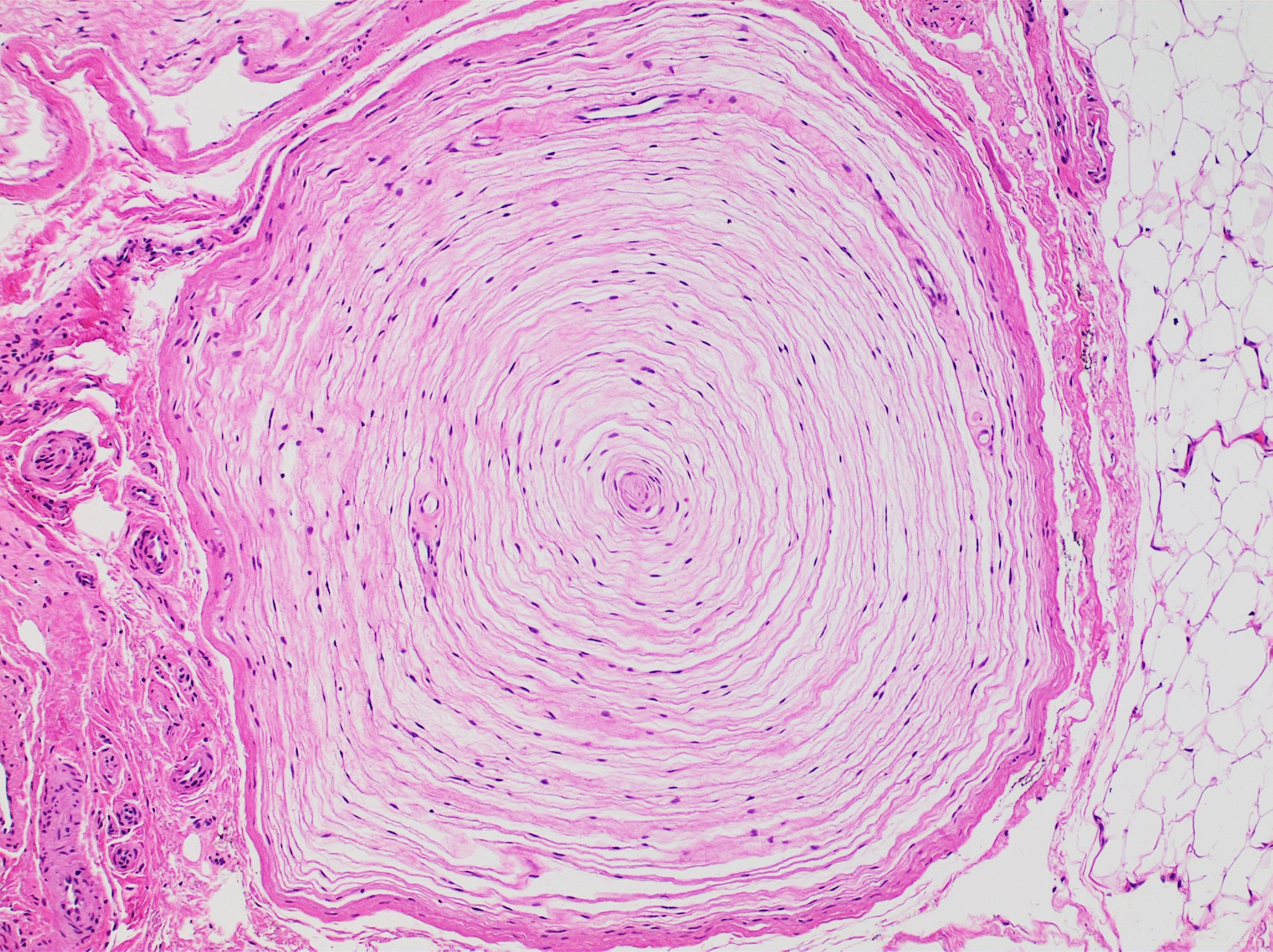
The vehicle is a coupled system too.
Road input, wheel and axle motion, spring stiffness, damping and chassis movement are related. MCP4SH looks for useful relationships in the telemetry rather than treating every raw value as a separate vibration effect.
Public domain; commercial reuse permitted
Vehicle movement
Movement is interpreted as a relationship, not a pile of isolated axes.
A vehicle can heave, pitch, roll, yaw, surge and sway. Those motions interact with suspension travel, load transfer, tyre state, acceleration and road input.
MCP4SH is not a replacement physics solver. It uses the state the simulator exposes, conditions it, compares related signals and translates the useful part into tactile semantics.
Earlier MCP4SH vibration research trail
Some of the sources cited while the early haptics rationale was being explained publicly.
These are part of the earlier public research trail around MCP4SH's haptic engineering rationale. They support the physical and perceptual context behind vehicle vibration, seating, steering-wheel vibration and transfer paths. They were never intended as a lookup table where one paper frequency becomes one MCP4SH effect.
Additional research
More context for perception, dynamics and sim-racing haptics.
Research honesty
What these sources support; and what MCP4SH does not claim.
| Supported | Not claimed |
|---|---|
| Tactile sensitivity depends on frequency, amplitude, timing and body location. | One receptor curve gives a universal "correct" frequency for an effect. |
| Vehicle vibration contains identifiable modes, harmonics, resonances and transfer paths. | MCP4SH reproduces every natural vehicle frequency one-to-one through a shaker. |
| Steering wheels, seats and sim-racing interfaces can carry useful information across multiple vibration bands. | One published band is optimal for every device, body location, rig and effect. |
| Hardware and receiver response materially change what reaches us. | Research papers remove the need for calibration, empirical testing or subjective validation. |
| The driving "string theory" analogy is a useful teaching model for coordinated steering and pedal input within a shared traction limit. | Steering and pedal inputs follow one universal linear ratio, or MCP4SH uses that coaching analogy as a literal effect formula. |